
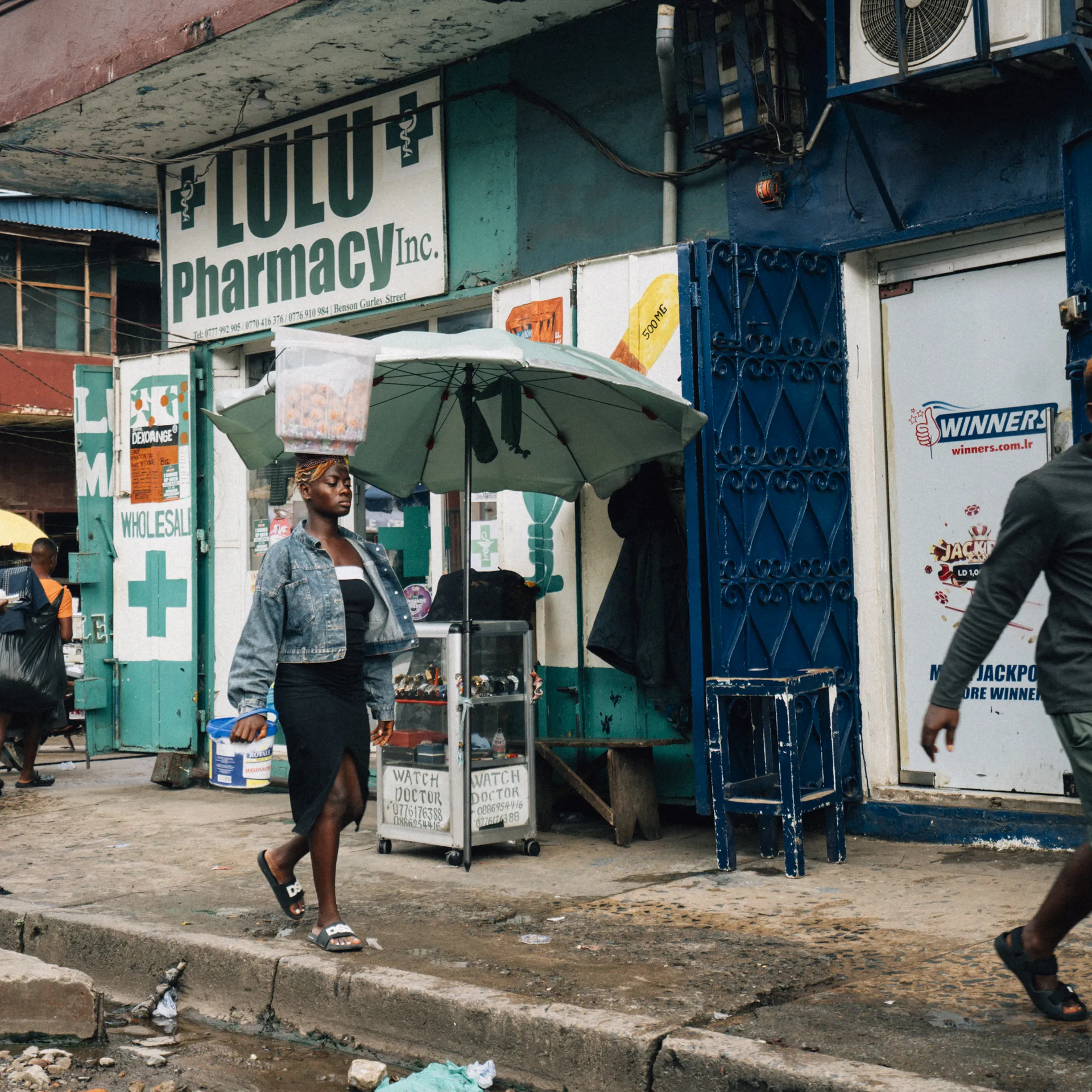
What Is Poverty in 2025?
In June 2025, the official count of the world's extreme poor jumped by 125 million overnight. Nobody lost a cent. The ruler changed.
The short version
Extreme poverty now means living on less than $3.00 a day, up from $2.15. The World Bank changed the line in June 2025.
About 808 million people, roughly one in ten, were expected to live below it in 2025. In sub Saharan Africa, it is nearly half of everyone.
Look beyond income and the count rises to 1.1 billion. Nearly eight in ten of them also live with extreme heat, floods, drought or polluted air.
Aid budgets started shrinking. The biggest donors began cutting, and the OECD expected aid to fall by as much as 17%.
The evidence for cash got stronger. In Kenya, a one time transfer cut infant deaths by 48%.
Poverty means not having enough to cover the basics: Food, a roof, clothes, school fees, a doctor when your child has a fever. Almost everyone agrees on that. The arguments start when you try to count it.
There are two main ways to do it. The money method draws a line, a daily amount of income or spending, and counts everyone below it. The World Bank does this for the whole world. The multidimensional method ignores money and asks what people actually go without: Schooling, health care, clean water, electricity, cooking fuel, a proper floor. UNDP and the University of Oxford publish that one every year.
Rich countries often use a third approach and set the line relative to what is normal locally. That is why someone counted as poor in Zurich could live comfortably in Freetown. This article sticks to the first two, because they describe poverty at its most severe.
Our 2024 edition covered the basics with the numbers of its time, and World Poverty Statistics 2024 put them in context. Why some countries end up poor in the first place is a different question, one we tried to answer for a curious child.
Why Did the Poverty Line Jump to $3.00?
Short answer: Better price data and better surveys. Not a worse world.
Since 1990, the World Bank has set its extreme poverty line by asking what the poorest countries themselves call poor. It collects the national poverty lines of low income countries, converts them into a common currency and takes the one in the middle. In 2025, that middle line belonged to Burkina Faso, at $3.04 a day. Rounded down, it became the new international poverty line: $3.00.
Those are not dollars at the exchange rate. They are purchasing power dollars, adjusted for local prices: $3.00 a day means living on what $3.00 bought in the United States in 2021. A cup of coffee, roughly. For food, rent, transport and everything else, all day.
So why the jump from $2.15? The World Bank breaks it down. About $0.35 comes from updated prices. The other $0.50 comes from better household surveys in low income countries. Those surveys now capture consumption more accurately, so the countries raised their own poverty lines, and the global line followed.
There have been five versions of the line since it was invented, from $1.00 to today's $3.00. Each move reflects new price data, not a decision that poor people deserve more.
Five versions of one line, from $1.00 to $3.00 a day:
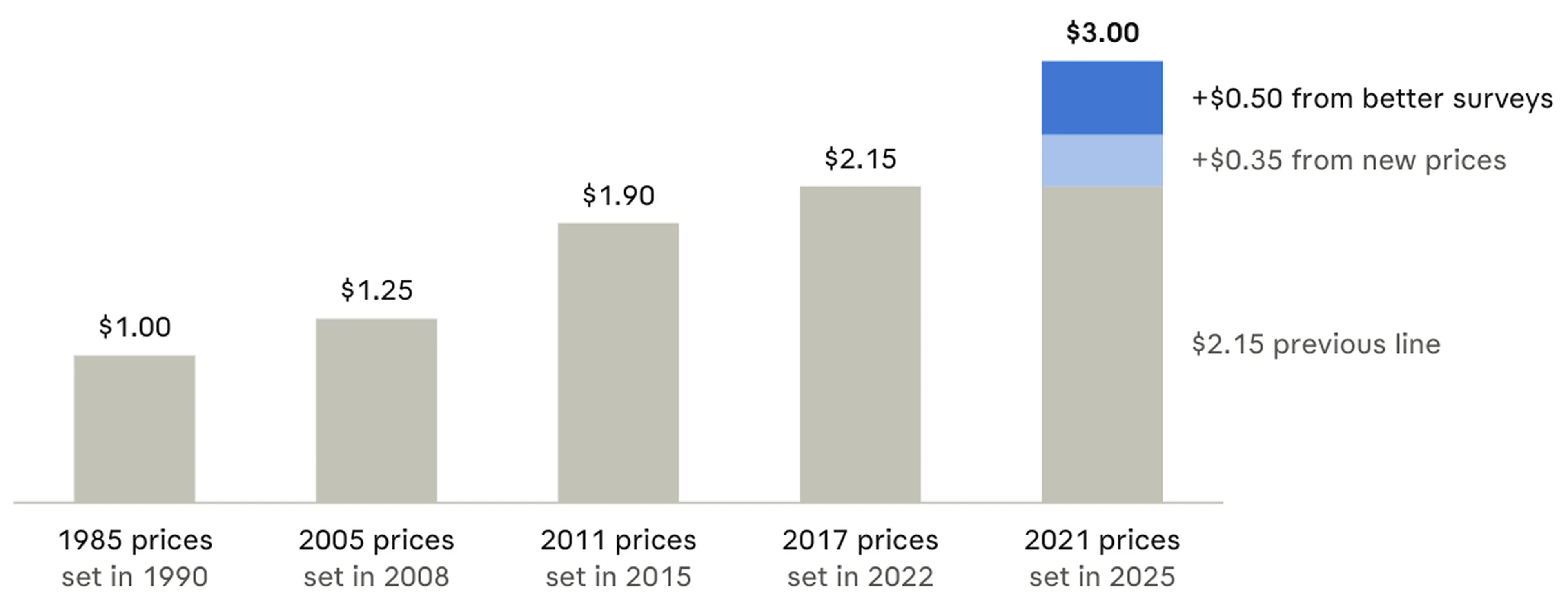
With a higher line, more people fall below it. The World Bank's estimate for 2022 rose from 713 million to 838 million people, an extra 125 million, 111 million of them in sub Saharan Africa. The Bank compares it to a doctor getting a better scanner. The patient did not get sicker. The picture got sharper.
How Many People Live in Extreme Poverty in 2025?
The World Bank expected 9.9% of the world to live below $3.00 a day in 2025 (World Bank). That is about 808 million people. More than everyone living in Europe. In September, new survey data nudged the World Bank's estimate up to 10.1%.
They are not spread evenly. In sub Saharan Africa, 45.5% of people lived in extreme poverty in 2022, about 559 million in total. With new data from Nigeria, the September update put the region's rate at 46% in 2024. South Asia went the other way: New survey data from India put its extreme poverty rate at 2.3%, and the region's count fell by 45 million in the revision. The Middle East and North Africa was the only region where extreme poverty rose between 2022 and 2025.
The long view is still good news: 1.5 billion people escaped extreme poverty between 1990 and 2022. The recent view is not. The World Bank projects that 9% of the world will still be extremely poor in 2030, the year the Sustainable Development Goals promised to end extreme poverty everywhere. That target is now out of reach.
One honest caveat. The data is thinnest exactly where poverty is deepest. When the line changed in June, survey coverage in sub Saharan Africa was below half, largely because there was no recent data for Nigeria. In Sierra Leone, where Social Income started, the last full household survey dates from 2018. It found 56.8% of people living below the national poverty line (World Bank).
What Does Poverty Look Like Beyond Income?
Money is a proxy for what people actually live with. The Global Multidimensional Poverty Index measures that directly. It counts someone as poor if they lack at least a third of ten basics across health, education and living standards.
In its 2025 edition, the index counted 1.1 billion people in acute poverty across 109 countries. For the first time, it also laid poverty over climate data. The result: 887 million of them live in places exposed to extreme heat, floods, drought or air pollution. And 651 million face two or more of those at once.
That overlap matters. A family with no savings cannot rebuild after a flood or wait out a failed harvest. Poverty turns a bad season into a crisis.
The same index shows that fast progress is possible: Some countries halved multidimensional poverty in under 15 years. We looked at how in What 25 Differing Countries Show Us About Ending Poverty.
What Changed for the People Trying to Help?
2025 was the year the biggest donors pulled back. The United States dismantled USAID, and the United Kingdom, France and Germany cut their aid budgets too. By the middle of the year, the OECD expected official development aid to fall by between 9% and 17%.
For organizations on the ground, that left one hard question: How do you do the most good with less money? We wrote about why the cuts could also be a turning point, toward trusting local people and toward localization.
So What Actually Works?
One answer got a lot stronger in 2025: Give people cash.
In August, economists from UC Berkeley and Oxford published new results from rural Kenya. Between 2014 and 2017, the nonprofit GiveDirectly had sent one time transfers of $1,000 by mobile money to more than 10,500 poor households. The researchers tracked over 100,000 births. Infant deaths fell by 48%. Deaths before age five fell by 45%. Hospital births rose by 45% (CEGA, UC Berkeley).
Nobody designed that program to save babies. It gave families money and let them decide. They chose to give birth in a clinic, feed their children better and rest in late pregnancy. The effect faded once the program ended, which says something about how long support needs to last.
It fits what decades of research already showed. People living in poverty know what they need better than anyone designing a program for them. And no, they do not spend it on alcohol: Thirty studies across three continents checked. Every other objection you have heard is in our Five Sticky Myths series.
“Overcoming poverty is not a gesture of charity. It is an act of justice.”
Where Does Social Income Fit?
Social Income sends unconditional cash transfers directly to people's phones in Sierra Leone, Liberia and Ghana. No middlemen, no conditions. Recipients decide what the money is for.
The money comes from contributors who give 1% of their income. Not a dramatic gesture, a fixed share: Little for the person giving, a lot for the person receiving. Here is why one percent.
How much reaches recipients matters as much as how much is given. Sending money to sub Saharan Africa usually costs close to 8% in fees, which we unpack in The 8% Problem Nobody Fixes. And if you wonder how we set the amount itself, read What's the Right Transfer Amount?

Riccardo Tamburini
Author (9 articles) · Communication
Volunteering since
Active in
Keep reading
What Is Poverty in 2026?
In 2026, about 811 million people live on less than $3.00 a day. One in ten of us. A number that has barely moved since the pandemic.
Where Physical Cash Has Its Limits
Mobile money is more than just convenience. It enables a whole new form of giving.

Talent Is Everywhere. The Floor Isn’t
Scott Santens says talent just needs a floor to stand on. He's right. But this floor matters most exactly where it's rarest: in the places Social Income works.