
What Is Poverty in 2026?
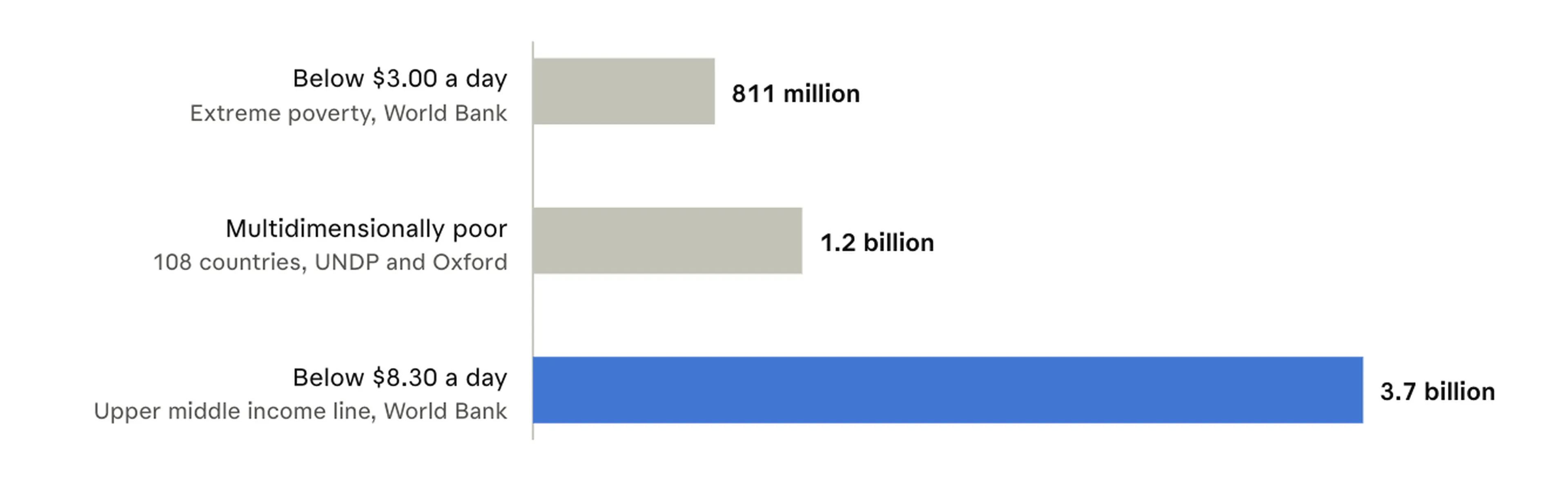
In 2026, about 811 million people live on less than $3.00 a day. One in ten of us. A number that has barely moved since the pandemic.
The short version
811 million people, one in ten, live in extreme poverty in 2026. The share has barely changed since the pandemic.
Multidimensional poverty rose for the first time since 2010, to 1.2 billion people. More than half are children.
3.7 billion people, almost half the world, live on less than $8.30 a day. About as many as in 1990.
Aid fell 23% in 2025, the largest annual drop on record.
The World Bank's answer is jobs. Cash in people's hands is one of the ways jobs get created.
The definition of extreme poverty has not changed since last year. The World Bank counts someone as extremely poor if they live on less than $3.00 a day, adjusted for what money buys locally. Why the line sits at $3.00 rather than $2.15 is the story of our 2025 edition. The basics are in the 2024 original.
What changed in 2026 is the tone. The two big annual reports, one from the World Bank and one from UNDP and Oxford, say the same thing in different words: Progress has stopped.
Because "poor" depends on where you draw the line, the World Bank uses three:
$3.00 a day: Extreme poverty, based on the poverty lines of the poorest countries.
$4.20 a day: The typical poverty line in lower middle income countries.
$8.30 a day: The typical poverty line in upper middle income countries.
How Many People Live in Poverty Right Now?
In its Poverty, Prosperity, and Planet Report 2026, published in October, the World Bank puts the number at 811 million people. Progress since the pandemic: Close to zero.
The bigger shock sits one line higher. 3.7 billion people, almost half the world, live on less than $8.30 a day, about as many as in 1990. That is what $8.30 bought in the United States in 2021. Think one sandwich, for a whole day. The share has fallen as the world's population grew. The number has not.
Even the exact count is a moving target. The World Bank's estimate for 2024 was 847 million in March and 824 million in September, after new survey data from South Asia came in. Numbers like these get revised as surveys arrive. The trend stays the same: Flat.
Where it is heading is worse. Without faster growth, the World Bank projects more people will be extremely poor in 2030 than today. Getting extreme poverty down to 3% by 2050 would take per person growth of about 4% a year, twice the pace of the last 25 years.
And where it lives keeps narrowing. More than half of the world's extremely poor live in just nine countries. By 2030, the World Bank expects 87% of them to live in sub Saharan Africa or in fragile and conflict affected places.
Why Did Poverty Rise for the First Time?
In October, UNDP and Oxford published the 2026 Global Multidimensional Poverty Index. The headline: 1.2 billion people live in acute poverty, 51.5 million more than in the previous update. It is the first increase since the index launched in 2010.
Who they are: 617 million are children, and 83% live in rural areas. In sub Saharan Africa, 616 million people, just over half the region, are multidimensionally poor.
Part of the rise is simple arithmetic. In 95 countries without new survey data, population growth alone added 15.8 million people to the count. In Angola and Zambia, the share of poor people actually fell, but the population grew faster, so the total still went up. A falling rate can hide a rising number. Both are true at once. Recipients decide what they need most.
“This is unacceptable. But it does not have to be this way.”
What Happened to Aid?
It fell off a cliff. Preliminary OECD figures published in April show official development aid dropped 23% in 2025, the largest annual fall on record and well beyond the 9% to 17% the OECD itself had forecast. The United States, the United Kingdom, France and Germany have now cut aid two years running, for the first time in nearly three decades (Rockefeller Foundation).
A peer reviewed study in The Lancet Global Health modeled what lasting cuts could mean: At least 9.4 million additional deaths by 2030 across 93 countries. It is a model, not a count. It also assumed a smaller cut than the one that actually happened.
We looked at what this shift could mean for the sector in Why U.S. Aid Cuts May Mark a Turning Point for Global Development.
If Jobs Are the Answer, Where Does Cash Fit?
The World Bank's 2026 report has one clear message: More and better jobs. It finds that getting three in four working age adults in poor households into work, mostly by closing the employment gap between women and men, would cut extreme poverty by about a fifth. Bringing poor workers' education up to the average of everyone above the poverty line would raise their earnings by around 40% and nearly halve extreme poverty.
Fair enough. But a job needs a customer. In a village where nobody has money to spend, the tailor has no orders and the farmer sells at a loss.
That is where cash comes in. In the same Kenyan villages where GiveDirectly sent $1,000 per household, researchers followed the money (CEGA, UC Berkeley). Recipients' spending rose by 13%, mostly on food and durable goods. Their neighbors, who received nothing, saw similar gains, because the money was spent in local shops, whose revenue grew. Prices barely moved: 0.1% inflation. And recipients did not work less.
Cash creates demand. Demand is what turns a skill into a job. Talent is everywhere; what is missing is a floor to stand on, as we argued in:
For what happens over decades, read Immediate Relief, Lasting Impact
For why we send cash rather than loans, Microcredits Sound Great
Is Anything Working?
Yes, and it deserves saying out loud. The same UNDP index shows that 33 countries halved multidimensional poverty in under 15 years, six of them in sub Saharan Africa. In Eswatini, the share of people in poverty fell from 38.7% to 8.0%. China halved it in four years, Viet Nam in seven.
When we looked at this question in January, we wrote about 25 such countries. The 2026 update counts 33. UNDP's reading is that progress comes fastest when countries tackle hunger, schooling, water and power together rather than one at a time.
Where Does Social Income Fit?
Aid is shrinking. Need is not. That gap will not close by itself.
Social Income's answer is small and stubborn: Ordinary people giving 1% of their income, sent as unconditional cash transfers straight to recipients' phones in Sierra Leone, Liberia and Ghana. No middlemen, no conditions, no shipping containers.
Fewer layers between contributor and recipient means less money lost on the way.
What Will 2027 Bring?
The numbers may move again next year, for a technical reason. New global price data from the International Comparison Program is due in 2027, and the last time new price data arrived, the poverty line jumped from $2.15 to $3.00 (World Bank). We will be back to explain what it means. All of 2026's figures, by region and by measure, are in World Poverty Statistics 2026.

Riccardo Tamburini
Author (9 articles) · Communication
Volunteering since
Active in
Keep reading
Where Physical Cash Has Its Limits
Mobile money is more than just convenience. It enables a whole new form of giving.

Talent Is Everywhere. The Floor Isn’t
Scott Santens says talent just needs a floor to stand on. He's right. But this floor matters most exactly where it's rarest: in the places Social Income works.
What’s the Right Transfer Amount?
There's no such thing as a perfect number. But there are ways to arrive at an amount that's grounded in local reality while remaining honest about limits. Here's how we get there.