

What Is Poverty?
Almost 700 million people live on less than $2.15 a day. At the current pace, ending extreme poverty could take three decades or more. It does not have to.
The short version
Extreme poverty means living on less than $2.15 a day. Almost 700 million people, 8.5% of the world, live below that line in 2024.
44% of humanity lives on less than $6.85 a day. That number has barely changed since 1990.
Count what people lack instead of what they earn, and 1.1 billion people are poor. More than half are children.
Cash works. Across 19 studies, giving people money did not raise spending on alcohol or tobacco.
Poverty means not having enough to meet your basic needs. Everyone agrees on that sentence. The hard part is deciding where "enough" ends, and there are two serious answers.
The money answer. The World Bank draws a line based on what the poorest countries themselves consider poor, converted into prices that compare across borders. In 2024, that line sits at $2.15 a day. Below it, you live in extreme poverty. It is not $2.15 at the exchange rate. It is what $2.15 bought in the United States in 2017: About one bus fare. For food, rent and everything else, for a whole day.
The everyday answer. UNDP and the University of Oxford ignore income and ask what people go without, across ten basics in health, education and living standards. Lack a third of them and you count as poor. Their 2024 index finds 1.1 billion people in that situation, most of them missing several basics at once.
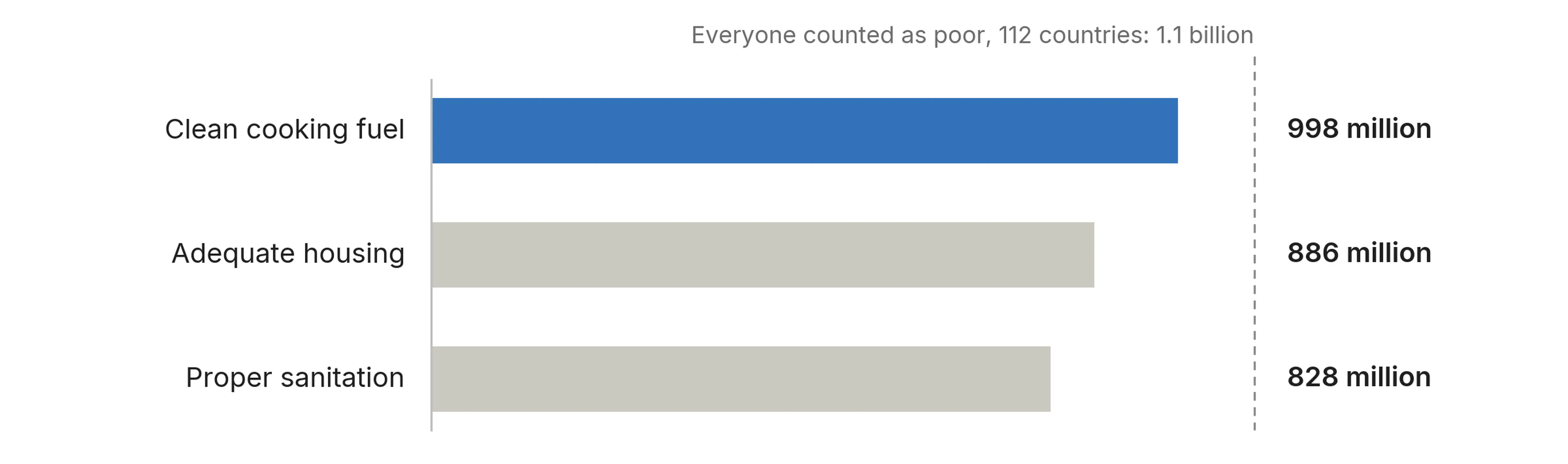
The two answers overlap, but they are not the same thing. That is why headlines quote different numbers for "the poor." Both are right. They measure different things.
How Many People Live in Poverty in 2024?
In October 2024, the World Bank published its Poverty, Prosperity, and Planet Report. The headline: Almost 700 million people, 8.5% of the world, live in extreme poverty. Most of them live in countries with a history of slow growth and fragility, many in sub Saharan Africa.
The trend is the problem. The Bank projects that 7.3% of the world will still be extremely poor in 2030, the year the Sustainable Development Goals promised to end extreme poverty. At the current pace, getting to zero could take three decades or more. The report itself warns that 2020 to 2030 risks becoming a lost decade.
One line higher, the picture gets harder. 44% of the world lives on less than $6.85 a day, the poverty line typical of upper middle income countries. Because the population kept growing, the number of people below that line has barely changed since 1990. At today's pace, ending poverty at that level could take more than a century.
Poverty also clusters where life is already hardest. 455 million of the 1.1 billion multidimensionally poor live in countries affected by violent conflict, where progress often stalls or reverses. And it falls hardest on the young: 27.9% of children live in multidimensional poverty, compared with 13.5% of adults. For more of the 2024 picture, see World Poverty Statistics 2024.
What Can We Do to Fight Poverty?
There is no single fix, and anyone who promises one is selling something. The World Bank's 2024 report argues for faster growth that creates jobs, investment in education and health, and protection against climate shocks. Its chief economist went further: In developing countries, he said, sustained investment in education and health pays off more than tax financed social assistance programs.
That is a fair point, and it is not an either or. Schools and clinics need to exist. But a family still needs the bus fare to reach the clinic, the uniform for school and food on the days the harvest fails. That is where one of the simplest tools comes in: Give people money.
Unconditional cash transfers are regular payments to people living in poverty, with no strings attached. No vouchers, no food parcels, no conditions. Recipients decide what they need most.
“Overcoming poverty is not a gesture of charity. It is an act of justice.”
Why Are Direct Cash Transfers So Effective?
Because people know what they need. A farmer in Sierra Leone knows better than any program officer in Geneva or Washington whether she needs seeds, a school fee or a new roof. Cash lets her choose. In kind aid has to guess.
Because they spend it well. The fear that cash ends up in alcohol and tobacco is old and persistent. A World Bank review by David Evans and Anna Popova tested it across 19 studies in Latin America, Africa and Asia. Almost without exception, cash transfers either made no difference to spending on alcohol and tobacco, or reduced it. We take the myth apart in They'll Just Spend It on Booze.
Because it is dignified. Handing out food or clothes tells people what they need. Handing over money treats them as adults who can decide. That changes how support feels, not just what it buys.
Because the money travels. Cash spent at the local market becomes income for the trader, the tailor and the farmer next door. Our 2026 edition shows how far that effect reaches. Over the long run, the gains can last for decades, as we explain in Immediate Relief, Lasting Impact.
How Does Social Income Do It?
Social Income was founded in Zurich in 2019 to send unconditional cash transfers directly to people's phones, starting in Sierra Leone. No middlemen, no conditions. Recipients decide what the money is for.
Donate your 1 %
The money comes from contributors who give 1% of their income. Little for the person giving, a lot for the person receiving.
Why one percent? We explain in One Percent Is Actually Ridiculous and Fighting Global Poverty with the Help of Everyday People.
Riccardo Tamburini
Author (7 articles) · Communication
Volunteering since
Active in
Keep reading
Where Physical Cash Has Its Limits
Mobile money is more than just convenience. It enables a whole new form of giving.

Talent Is Everywhere. The Floor Isn’t
Scott Santens says talent just needs a floor to stand on. He's right. But this floor matters most exactly where it's rarest: in the places Social Income works.
What’s the Right Transfer Amount?
There's no such thing as a perfect number. But there are ways to arrive at an amount that's grounded in local reality while remaining honest about limits. Here's how we get there.