
World Poverty Statistics 2024
In 2024, about one person in twelve lives on less than $2.15 a day. Two in three of them live in sub Saharan Africa. Here are the numbers behind global poverty.
This page was first published in April 2024. We have since rebuilt it around the figures the World Bank, the United Nations, UNICEF and the FAO published over the course of 2024, and every number now says which year it describes and links to where it comes from. If you want to know what poverty actually means and how it is measured, start with What Is Poverty?
A quick note on the yardstick. In 2024, the World Bank defines extreme poverty as living on less than $2.15 a day, adjusted for what money buys in each country. It uses two higher lines as well: $3.65 a day, typical of lower middle income countries, and $6.85 a day, typical of upper middle income countries.
How Many People Live in Extreme Poverty in 2024?
The World Bank's Poverty, Prosperity, and Planet Report 2024 puts the number at almost 700 million people, or 8.5% of the world. Its September 2024 data update estimates about 692 million for the year.
The pandemic pushed the global rate up to 9.7% in 2020. By 2024 it had fallen back to roughly where it stood before, but low and lower middle income countries recovered more slowly than the rest.
Progress has slowed sharply. The World Bank expects about 69 million people to escape extreme poverty between 2024 and 2030, compared with about 150 million between 2013 and 2019 (World Bank). On that path, 622 million people, 7.3% of the world, will still be extremely poor in 2030, the year the Sustainable Development Goals promised to end extreme poverty. At the current pace, getting to zero could take three decades or more.
Where Do the World's Poorest People Live?
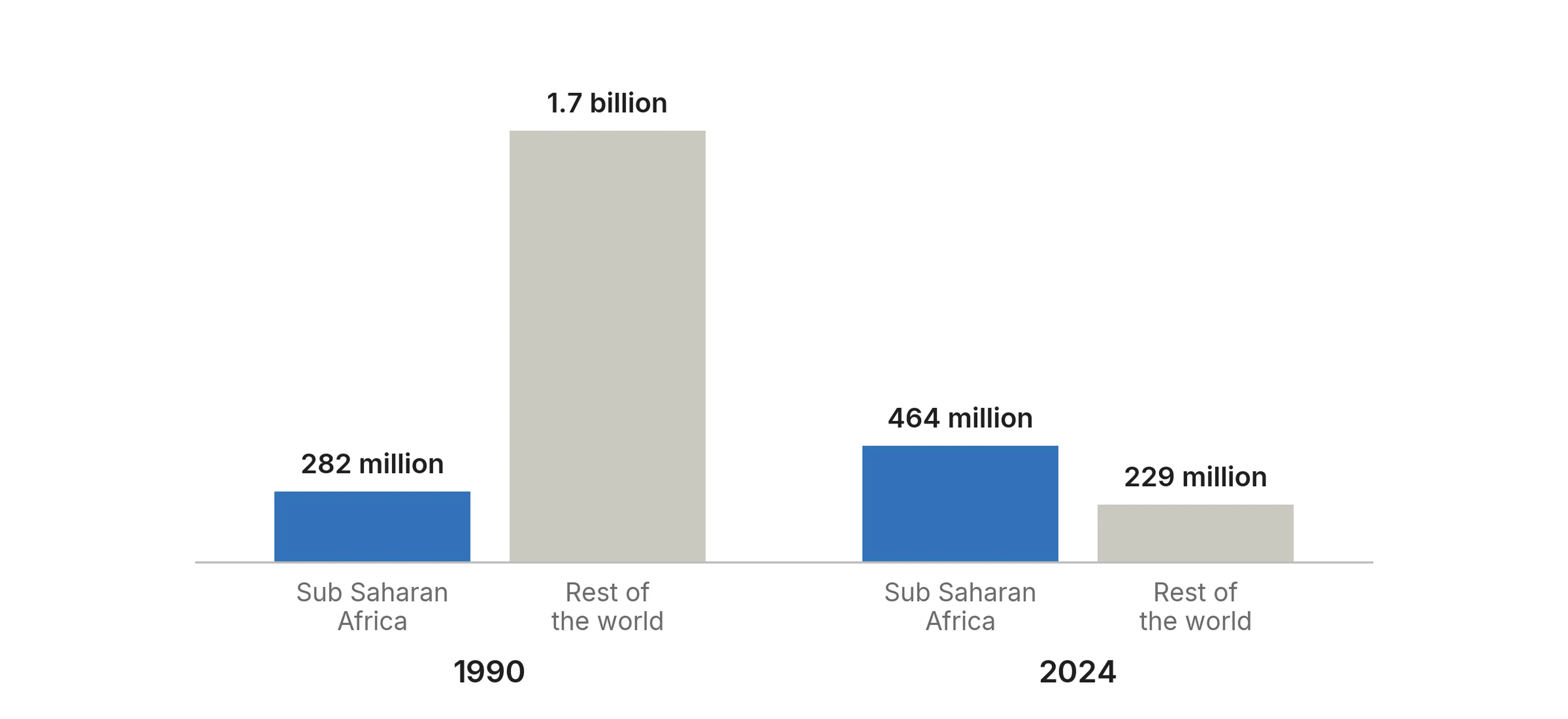
In 1990, more than half of the world's extremely poor people lived in East Asia and the Pacific, 28% in South Asia and only 14.1% in sub Saharan Africa (World Bank). Since then, hundreds of millions of people in East Asia have left extreme poverty behind. Sub Saharan Africa has not kept pace: The number of extremely poor people there rose from 282 million in 1990 to 464 million in 2024.
Today, sub Saharan Africa is home to 16% of the world's population but 67% of its extremely poor people. Add the fragile and conflict affected countries elsewhere, and the share rises to three quarters (World Bank).
GRAPH
How Many Children Live in Poverty?
The most recent estimate from UNICEF and the World Bank, published in September 2023, counts 333 million children in extreme poverty in 2022, or one child in six. Children make up more than half of the world's extremely poor, although they are only a third of its population.
Sub Saharan Africa carries the heaviest load. 40% of its children live in extreme poverty, and the region is home to 71.1% of the world's extremely poor children. In countries affected by conflict and fragility, one child in three lives in an extremely poor household, compared with one in ten elsewhere.
At the higher lines, the numbers grow fast: 829 million children live on less than $3.65 a day, and 1.43 billion on less than $6.85.
How Many People Go Hungry?
The State of Food Security and Nutrition in the World 2024 estimates that between 713 and 757 million people faced hunger in 2023. At the midpoint, 733 million, that is one person in eleven worldwide and one in five in Africa. It is also about 152 million more people than in 2019.
If current trends continue, around 582 million people will still be chronically undernourished in 2030, half of them in Africa.
What Does Poverty Look Like Beyond Income?
Income is only one way to count. The 2024 Global Multidimensional Poverty Index from UNDP and the University of Oxford checks ten basics across health, education and living standards. It finds 1.1 billion poor people among the 6.3 billion living in the 112 countries it covers.
More than half of them are children: 584 million. 27.9% of children live in multidimensional poverty, compared with 13.5% of adults.
455 million live in countries affected by war, fragility or low peacefulness. In countries at war, more than one person in three is poor (34.8%). In countries not affected by conflict, it is about one in nine (10.9%).
637 million live with at least one undernourished person in their household.
For the basics people in multidimensional poverty go without most often, from cooking fuel to sanitation, see the chart in What Is Poverty?
Is Poverty Going Down?
Over the long run, yes. The share of the world in extreme poverty fell from 38% in 1990 to 8.5% in 2024 (World Bank).
Over the last decade, barely. The World Bank says global poverty reduction has slowed to a near standstill, and at the $6.85 line, ending poverty at today's pace could take more than a century.
Two more numbers from the same report help explain why. 1.7 billion people, 20% of the world, live in countries with high income inequality, mostly in Latin America and the Caribbean and in sub Saharan Africa. And nearly one person in five worldwide is likely to face a severe weather shock in their lifetime that they will struggle to recover from. We looked at what actually reduces inequality in How to Reduce Income Inequality? (INTERNAL)
The goal the world set itself is Sustainable Development Goal 1: End poverty in all its forms everywhere, with extreme poverty eradicated by 2030.
“The opposite of poverty is justice”
What Can You Do About It?
The numbers are big. The answer can be small and direct. Social Income sends unconditional cash transfers straight to people's phones in West Africa, funded by contributors who give 1% of their income. No middlemen, no conditions. Recipients decide what they need most.
Why cash, and why one percent? We explain in What Is Poverty?, Doing Something Beats Doing Nothing and Fighting Global Poverty with the Help of Everyday People.
The Sustainable Development Goal (SDG) 1, also known as the “No Poverty“ goal, is a global effort to eradicate extreme poverty and reduce income inequality by 2030. This goal is of utmost importance because poverty is a pervasive and complex issue that affects billions of people around the world. It can have serious consequences for individuals, communities, and economies, including poor health, limited access to education and other essential services, and reduced economic opportunity.
What Happened Next?
This edition shows global poverty as it stood in 2024. In 2025, the World Bank replaced the $2.15 line with a new one of $3.00 a day, and the count of the world's poorest went up. The newer numbers are in World Poverty Statistics 2025 and World Poverty Statistics 2026.
If you would rather change a number than read one, start with 1%.
Donate your 1 %

Sandino Scheidegger
Author (18 articles) · Management
Founder of Social Income
Volunteering since
Keep reading
Where Physical Cash Has Its Limits
Mobile money is more than just convenience. It enables a whole new form of giving.

Talent Is Everywhere. The Floor Isn’t
Scott Santens says talent just needs a floor to stand on. He's right. But this floor matters most exactly where it's rarest: in the places Social Income works.
What’s the Right Transfer Amount?
There's no such thing as a perfect number. But there are ways to arrive at an amount that's grounded in local reality while remaining honest about limits. Here's how we get there.