
What Is Poverty in 2025?
In 2025, the World Bank moved its extreme poverty line to $3.00 a day. By that measure, about one in ten people are extremely poor, and progress has slowed. Here are the numbers.
The short version:
The extreme poverty line is now $3.00 a day. In June 2025, the World Bank raised it from $2.15, based on new price data and better household surveys.
839 million people, 10.3% of the world, lived in extreme poverty in 2024, according to the World Bank's September 2025 update. Its estimate for 2025 is 10.1%.
46% of people in sub Saharan Africa lived in extreme poverty in 2024.
About 412 million children lived in extreme poverty in 2024, one child in five.
About 673 million people faced hunger in 2024, 8.2% of the world. In Africa, it was more than one in five.
887 million of the 1.1 billion people in multidimensional poverty live in places exposed to climate hazards.
2025 was the year the yardstick changed. In June, the World Bank replaced its $2.15 extreme poverty line with a new line of $3.00 a day, and the count of the world's poorest went up overnight. That makes this year's numbers hard to compare with older ones, including those in our 2024 edition. This page uses the new line throughout and states the year each figure describes. Why the line moved is explained in What Is Poverty in 2025? (RELINK)
The World Bank now uses three lines: $3.00 a day for extreme poverty, $4.20 a day as the line typical of lower middle income countries, and $8.30 a day as the line typical of upper middle income countries (World Bank).
How Many People Live in Extreme Poverty?
Under the new line, the World Bank's June 2025 update revised its estimate for 2022 from 713 million to 838 million people, 10.5% of the world.
Its September 2025 update added new survey data, including the first recent figures for Nigeria, and put the number for 2024 at 839 million people, or 10.3%. Its estimate for 2025 is 10.1%, about one person in ten.
The long view still shows enormous progress: 1.5 billion people escaped extreme poverty between 1990 and 2022. The short view does not. The World Bank projects that 9% of the world will still be extremely poor in 2030 (World Bank).
One line up, the picture barely moves. About 3.8 billion people lived on less than $8.30 a day in 2022, slightly more than the 3.7 billion of 1990.
Where Do the World's Poorest People Live?
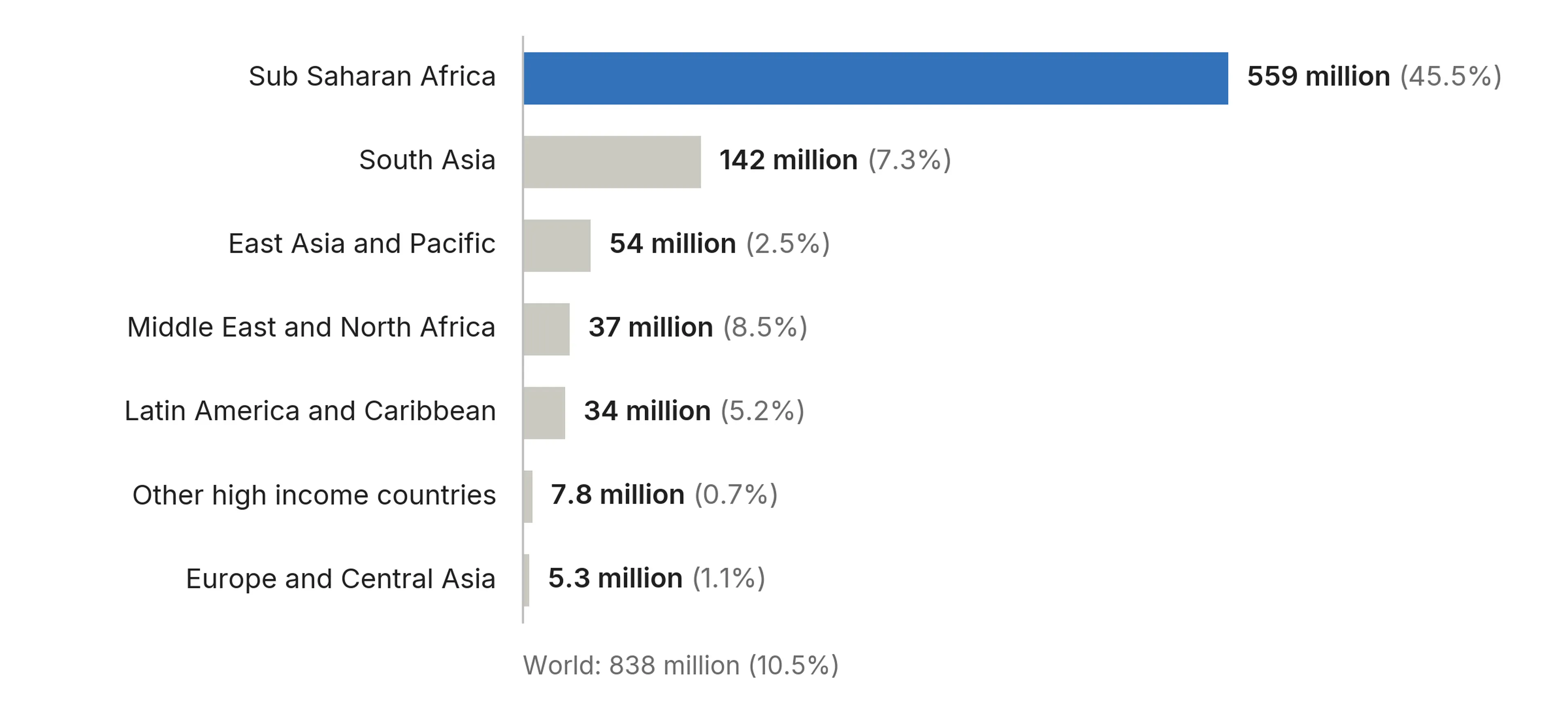
In 2022, sub Saharan Africa had 559 million people in extreme poverty, 45.5% of its population and two thirds of the world total. With the new data from Nigeria, the World Bank's September update puts the region's rate at 46.0% in 2024, highest in Eastern and Southern Africa.
South Asia went the other way. New survey data from India showed extreme poverty there falling from 16.2% in 2011/12 to 2.3% in 2022/23 (World Bank), and South Asia saw the largest decline of any region between 2022 and 2025.
The Middle East and North Africa was the only region where extreme poverty rose between 2022 and 2025, from 8.5% to 9.4%. Since September 2025, the World Bank counts Afghanistan and Pakistan in that region, which now has the second highest extreme poverty rate in the world, about one person in eight.
How Many Children Live in Poverty?
New estimates from the World Bank and UNICEF, published in September 2025, count about 412 million children in extreme poverty in 2024, 19.2% of all children. That is down from 507 million, or 24%, in 2014.
Children are 30% of the world's population but more than half of its extremely poor. Sub Saharan Africa is home to about 23% of the world's children and about three quarters of the children in extreme poverty, over 312 million. There, the extreme child poverty rate was around 52% in 2024, the same as in 2014.
How Many People Go Hungry?
The State of Food Security and Nutrition in the World 2025 found that about 673 million people faced hunger in 2024, or 8.2% of the world, down from 8.5% in 2023 and 8.7% in 2022.
The fall was not shared. In Africa, hunger rose above 20% of the population, affecting 307 million people. In Western Asia, 12.7% may have faced hunger. If trends continue, 512 million people could be chronically undernourished in 2030, almost 60% of them in Africa.
What Does Poverty Look Like Beyond Income?
The 2025 Global Multidimensional Poverty Index from UNDP and the University of Oxford counts 1.1 billion people in acute multidimensional poverty. For the first time, it laid that poverty over climate data.
887 million poor people, nearly eight in ten, are directly exposed to at least one climate hazard: Extreme heat, flooding, drought or air pollution.
651 million face two or more at once, and 309 million face three or four.
The most widespread hazards are high heat, affecting 608 million poor people, and air pollution, affecting 577 million. Floods affect 465 million and drought 207 million.
In South Asia, 99.1% of poor people are exposed to at least one hazard. In sub Saharan Africa, 344 million are.
What Happened to Aid in 2025?
Aid started shrinking. According to the OECD, official development assistance fell by 9% in net terms in 2024, and in June 2025 the OECD projected a further drop of 9% to 17% in 2025. For sub Saharan Africa, it projected bilateral aid to fall by 16% to 28%.
The final count, published in April 2026, was worse: A 23% fall, the largest on record. The details are in our 2026 edition (RELINK). What the cuts could mean for the sector, we looked at in Why U.S. Aid Cuts May Mark a Turning Point for Global Development.
What Can You Do About It?
The numbers above are the reason Social Income exists. We send unconditional cash transfers directly to people's phones in West Africa, funded by contributors who give 1% of their income. No middlemen, no conditions. Recipients decide what they need most.
Why a guaranteed floor matters most where it is rarest, we argue in Talent Is Everywhere. The Floor Isn't. Why every percent lost to fees matters, in The 8% Problem Nobody Fixes. And the strongest new evidence for cash from 2025, a study of 100,000 births in Kenya, is in What Is Poverty in 2025? (RELINK)
What Comes Next?
Update: The 2026 numbers show a world that stopped making progress on poverty and, by one major measure, slipped back. They are in World Poverty Statistics 2026.
If you would rather change a number than read one, start with 1%.
Donate your 1 %

Sandino Scheidegger
Author (18 articles) · Management
Founder of Social Income
Volunteering since
Keep reading
Where Physical Cash Has Its Limits
Mobile money is more than just convenience. It enables a whole new form of giving.

Talent Is Everywhere. The Floor Isn’t
Scott Santens says talent just needs a floor to stand on. He's right. But this floor matters most exactly where it's rarest: in the places Social Income works.
What’s the Right Transfer Amount?
There's no such thing as a perfect number. But there are ways to arrive at an amount that's grounded in local reality while remaining honest about limits. Here's how we get there.