
World Poverty Statistics 2026
For the first time, Africa has more hungry people than Asia: 309 million against 292 million in 2025. Here are the numbers that define global poverty in 2026.
The short version
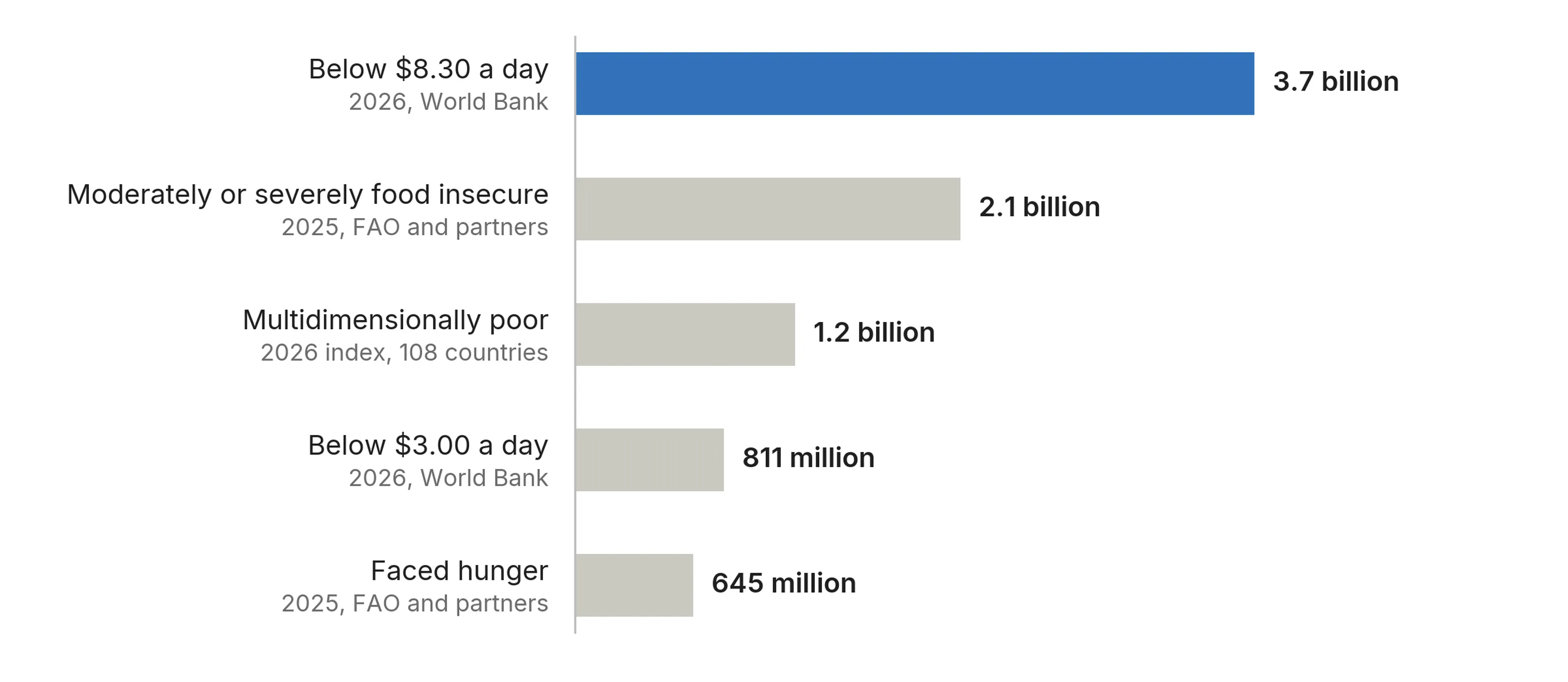
811 million people, one in ten, live in extreme poverty in 2026, a rate the World Bank says has not changed since 2019.
3.7 billion people, nearly half the world, live on less than $8.30 a day, about as many as in 1990.
1.2 billion people are multidimensionally poor, 51.5 million more than in the previous count and the first increase since 2010. 617 million of them are children.
About 645 million people faced hunger in 2025, 7.8% of the world, the third yearly decline in a row.
Aid fell 23.1% in 2025 to $174.3 billion, the largest drop on record. The OECD expects about 7% less again in 2026.
By 2030, 87% of the extremely poor will live in sub Saharan Africa, in fragile and conflict affected places, or both.
2026 tells two stories at once. On hunger, the world improved for a third year in a row. On poverty, it stood still, and by one major measure it went backwards. Meanwhile, the money meant to help fell by more than in any year on record. For what poverty means and how it is measured, read What Is Poverty in 2026? (INTERNAL) For earlier numbers, see our 2024 and 2025 editions.
How Many People Live in Extreme Poverty in 2026?
The World Bank's Poverty, Prosperity, and Planet Report 2026, published in October, puts the number at 811 million people, one in ten, living on less than $3.00 a day. The share has barely moved since 2019 (World Bank).
Its September 2026 data update estimates 824 million people, 10.1% of the world, for 2024, the latest year with full survey coverage, and projects a small decline to 9.8% in 2026. Six months earlier, the estimate for 2024 had been 847 million. New survey data from South Asia, including India, brought it down.
The outlook is worse than the present. Without faster growth, the World Bank projects more people in extreme poverty in 2030 than today. To bring extreme poverty down to 3% by 2050, income per person would need to grow by about 4% a year, twice the pace of the last 25 years.
One line up, 3.7 billion people, nearly half the world, live on less than $8.30 a day, a number that has barely changed since 1990.
Where Is Extreme Poverty Concentrated?
Extreme poverty rates are now below 5% in every region except two: Sub Saharan Africa, where they remain high, and the Middle East, North Africa, Afghanistan and Pakistan, where they are rising (World Bank).
More than half of the world's extremely poor people live in just nine economies. By 2030, the World Bank expects 87% of them to live in sub Saharan Africa, in fragile and conflict affected places, or both.
How Many People Are Poor Beyond Income?
The 2026 Global Multidimensional Poverty Index from UNDP and the University of Oxford counts 1.2 billion people in acute poverty, 51.5 million more than in the previous update. It is the first increase since the index began in 2010.
617 million of them are children, and 83% live in rural areas.
In sub Saharan Africa, 616 million people, 51.4% of the population, are multidimensionally poor (UNDP).
Part of the rise is population growth. In 95 countries without new survey data, it alone added 15.8 million people. In Angola and Zambia, the share of poor people fell, but the population grew faster, so the number still went up.
Fast progress is still possible: 33 countries halved multidimensional poverty in less than 15 years, six of them in sub Saharan Africa. In Eswatini, the share fell from 38.7% to 8.0%.
What countries that cut poverty fast have in common, we looked at in What 25 Differing Countries Show Us About Ending Poverty.
How Many People Go Hungry?
The State of Food Security and Nutrition in the World 2026 estimates that about 645 million people faced hunger in 2025, 7.8% of the world, down from 8.1% in 2024 and 8.6% in 2022. That is the third yearly decline in a row and about 43 million fewer people than in 2022.
Africa is now home to about 309 million hungry people, Asia to 292 million. It is the first time Africa has the larger number.
About 2.1 billion people, 25.8% of the world, were moderately or severely food insecure in 2025.
23.2% of children under five were stunted in 2024, 150.2 million children (UNICEF).
Between 510 and 520 million people may still face hunger in 2030.
How Many Children Live in Poverty?
The most recent estimate from the World Bank and UNICEF, published in September 2025, counts about 412 million children in extreme poverty in 2024, one child in five. The details are in our 2025 edition. Beyond income, the 2026 multidimensional index counts 617 million poor children.
What Happened to Aid?
According to preliminary OECD data published in April 2026, official development assistance fell by 23.1% in 2025, to $174.3 billion, the largest annual drop on record. In 2024 it had been $214.6 billion. Aid now equals 0.26% of donor countries' combined national income, down from 0.34%.
The United States cut its aid by 56.9%. For the first time, Germany became the largest donor, with $29.1 billion.
Bilateral aid to sub Saharan Africa fell by 26.3%, and humanitarian aid by 35.8%.
The OECD projects a further decline of about 7% in 2026 (OECD).
A peer reviewed study in The Lancet Global Health modeled what sustained cuts could mean: At least 9.4 million additional deaths by 2030 across 93 countries. It is a model, not a count. What the shift could mean for organizations on the ground, we looked at in Why U.S. Aid Cuts May Mark a Turning Point for Global Development.
What Can You Do About It?
When governments give less, what everyday people give matters more. Social Income sends unconditional cash transfers directly to people's phones in West Africa, funded by contributors who give 1% of their income. No middlemen, no conditions. Recipients decide what they need most.
Why cash works, including what it does for local jobs, is in What Is Poverty in 2026? (INTERNAL) What happens to people over the decades after a cash transfer, in Immediate Relief, Lasting Impact.
What Will 2027 Bring?
The numbers may move again for a technical reason. New global price data from the International Comparison Program is due in 2027, and the last time new price data arrived, the extreme poverty line rose from $2.15 to $3.00 (World Bank). We will publish the 2027 edition once the new figures are out.
Until then, poverty is not shrinking on its own. If you want to push, start with 1%.
Donate your 1 %

Sandino Scheidegger
Author (18 articles) · Management
Founder of Social Income
Volunteering since
Keep reading
Where Physical Cash Has Its Limits
Mobile money is more than just convenience. It enables a whole new form of giving.

Talent Is Everywhere. The Floor Isn’t
Scott Santens says talent just needs a floor to stand on. He's right. But this floor matters most exactly where it's rarest: in the places Social Income works.
What’s the Right Transfer Amount?
There's no such thing as a perfect number. But there are ways to arrive at an amount that's grounded in local reality while remaining honest about limits. Here's how we get there.